You can probably find a million articles written over the past two decades about the different (sometimes “fancy”) labels companies slap on their poultry products to market them in a way that’s perceived as “healthy.”
We’re adding our own post to the mix because we like to do our own research- and we want to be 100% transparent with our sources.
Navigating the Labels
- look for a “Certified Humane” label (or similar) in the store, meaning the farm the chicken came from has been officially inspected to ensure specific standards are being held to
OR
- KNOW YOUR FARMER. Many smaller producers are not able to pay the heavy fees associated with certification applications and inspections, but we’re happy to show you how we raise our animals and answer any questions you have!
We are not currently “certified” in any way, BUT our birds are fed a freshly milled, certified organic feed and spend their feathered lives (when they are able to maintain their own body heat) on a pasture fertilized only by waste hay and chicken and goat manure. They do not receive antibiotics or vaccines. Their open-air enclosures are designed to protect them from predators while being easily moved to fresh pasture daily.
What's so great about "Pasture-Raised"?
The descriptions we’ve already looked at seem to only discuss the quality of life enjoyed by the birds that are raised in these various conditions. And while it is true that (as we often say) “pasture-raised birds live their best lives until that ‘one bad day,'” it’s also true that pasture-raised meat has proven to be healthier in many ways than barn-raised meat, in large part due to what these birds eat.
The diets of most commercially-raised chickens consist of grain-based feeds (featuring corn, wheat, oats, barley, etc.), but as we mentioned above, chickens are by nature “opportunistic omnivores,” eating not only grains, but also available grasses and seeds, and even bugs and other small animals they may find. Recent research has looked deeper into the effects that such a limited diet has on the nutrient value of meat produced by it. We’ve outlined several of these studies below and included a table that you may find helpful.
Spoiler alert: Pasture-raised birds have health benefits!
In 2008, a study by Ponte, et al [5], tested the differences of the lipid nutritive value of meat produced by two groups of birds. Both groups were fed a “cereal-” (or grain-) based feed; one group was also provided with access to “leguminous-based forage” (composed primarily ryegrass and clover). At the end of the testing period, the birds and the breast meat from each group was compared. The addition of forage had no significant impact on the growth of the bird or on the cholesterol, Vitamine E, or total lipid content of the breast meat; however, the forage did seem to have a positive impact on the “fatty acid profile,” increasing the levels of n-3 LC PUFAs (Omega-3s) in the meat.
Another study, published in 2012 by Sun, et al [7], examined the fatty acid and cholesterol levels of the breast meat produced by pasture-raised broilers allowed to enjoy the over-abundant grasshopper population in the Tibetan Plateau in addition to a corn-based feed. These were compared to those levels in the breast meat from a control group raised in indoor cages and provided a “commercial compound diet.” These results showed that pastured chicken meat was lower in cholesterol, lower in saturated fat (though not significantly), and higher in Omega-3 fatty acids. It also had a higher PUFA (Polyunsaturated Fatty Acid) to SFA (Saturated Fatty Acid) ratio.
Pasture raised poultry producers who have been able to perform nutritional testing on their meat birds [3,8] have found that those raised on pasture have more Omega-3 fatty acids, lower saturated fats, and a lower Omega-6:Omega-3 ratio, while also containing more of Vitamins A, D, and E.
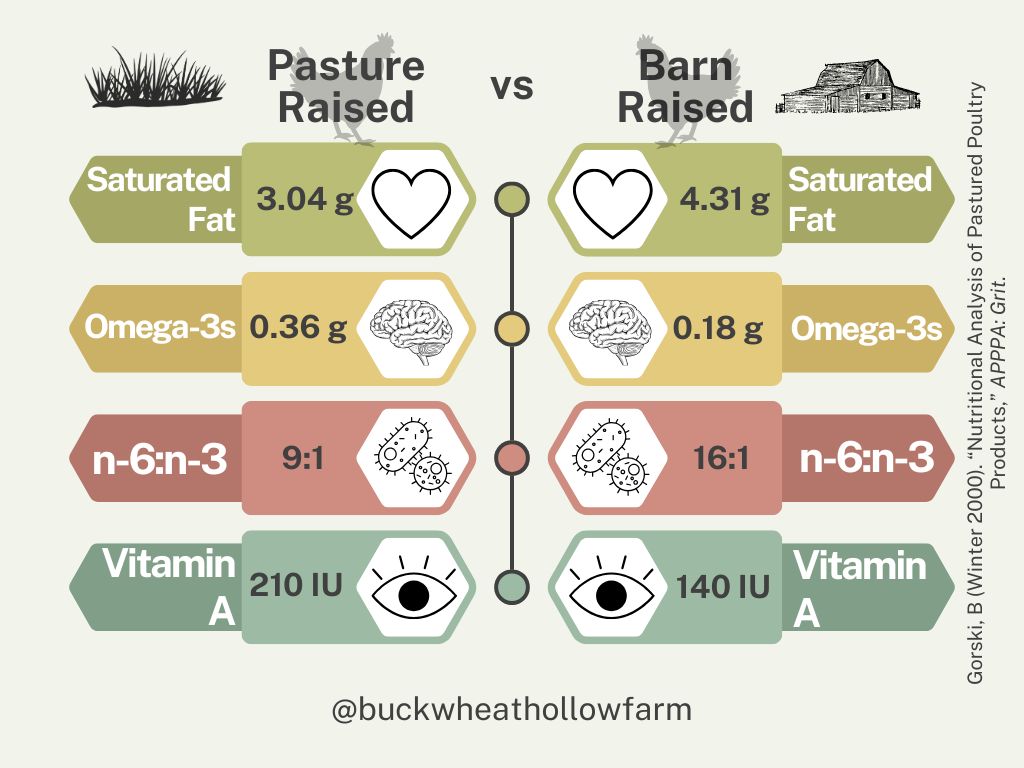
Vitamins A, D, and E are important for healthy vision, bones, skin, and immune systems (among other things); the levels of saturated fat, unsaturated fat, and cholesterol in our food play a critical role in our heart health.
So what about me?
Sources
[1] About the Organic Standards (n.d.). U.S. Department of Agriculture. Retrieved April 7, 2026 from https://www.ams.usda.gov/grades-standards/organic-standards.
[2] FSIS Guideline on Substantiating Animal-Raising or Environment-Related Labeling Claims (August 2024). U.S. Department of Agriculture.
[3] Gorski, Barb (Winter 2000). Nutritional Analysis of Pastured Poultry Products. APPPA Grit. https://www.apppa.org/page-18106.
[4] Meat and Poultry Labeling Terms (July 2024). U.S. Department of Agriculture. Retrieved April 7, 2026 from https://www.fsis.usda.gov/food-safety/safe-food-handling-and-preparation/food-safety-basics/meat-and-poultry-labeling-terms.
[5] Ponte, P.I.P. et al. (August 2008). Improving the Lipid Nutritive Value of Poultry Meat Through the Incorporation of a Dehydrated Leguminous-Based Forage in the Diet for Broiler Chicks. Poultry Science, 87(8), 1587-1594.
[6] Questions and Answers – USDA Shell Egg Grading Service (Octover 2015). U.S. Department of Agriculture. Retrieved April 7, 2026 from https://www.ams.usda.gov/publications/qa-shell-eggs.
[7] Sun, T. et al (February 2012). Meat fatty acid and cholesterol level of free-range broilers fed on grasshoppers on alpine rangeland in the Tibetan Plateau. Journal of the Science of Food and Agriculture, 92, 2239-2243.
[8] The Top Benefits of Pasture Raised Chicken (n.d.). Pasturebird. Retrieved April 7, 2026 from https://www.pasturebird.com/blogs/farmtalk/the-top-benefits-of-pasture-raised-chicken.