Who Eats Goat Meat?
But Why Goat?
One of the reasons goat is so popular is economical. They primarily consume browse (shrubby plants, leaves, twigs, etc.), which allows them to thrive in untamed, atypical agricultural areas such as scrublands and mountains. In many of these areas they are also allowed to “free-range” with minimal herd management, compared to other meat animals. [1]
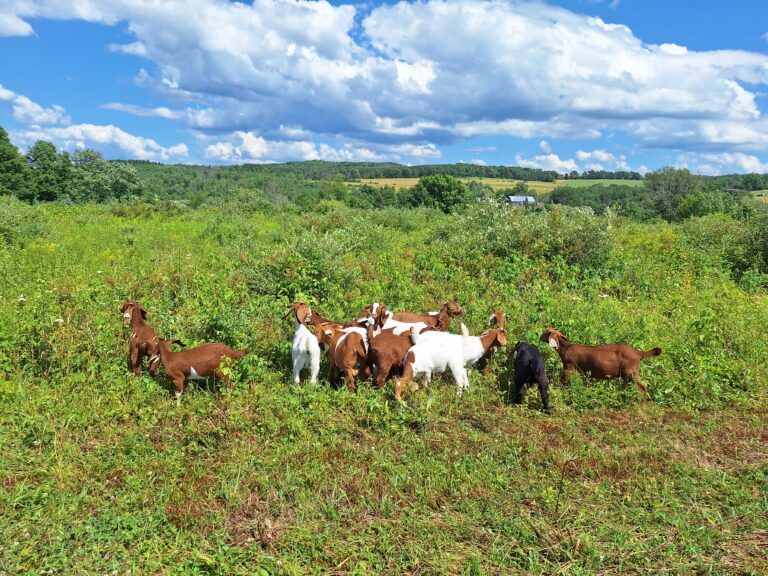
In large part, this aspect of goat farming is what encouraged us to take Buckwheat Hollow Farm in the direction we have. When we first visited our farm in 2024, we were surprised to find areas that were once prime pasture-land being slowly taken over by the invasive autumn olive and honeysuckle shrubs. After some research, we realized that goats could not only help us rehab our pastures and cut back on this pestilential, non-native vegetation…they would actually thrive while doing so.
Another significant reason for the popularity of goat is nutritional. As a source of protein, fat, vitamins, and minerals, meat is an important part of our diet; however, higher levels of saturated fat and cholesterol present in red meat has marked it as “undesirable” due to association with obesity and metabolic diseases. [5] Contrary to other red meats, though, goat is a lean source of protein, in addition to being a good source of amino acids, vitamins, minerals, and polyunsaturated fatty acids. [3]
The chart below contains information from the USDA FoodData Central archive for 100g cooked goat meat [6] and 100g cooked beef tenderloin [7]. While both red meats are high in protein and iron, goat meat is lower in saturated fat and higher in zinc.*
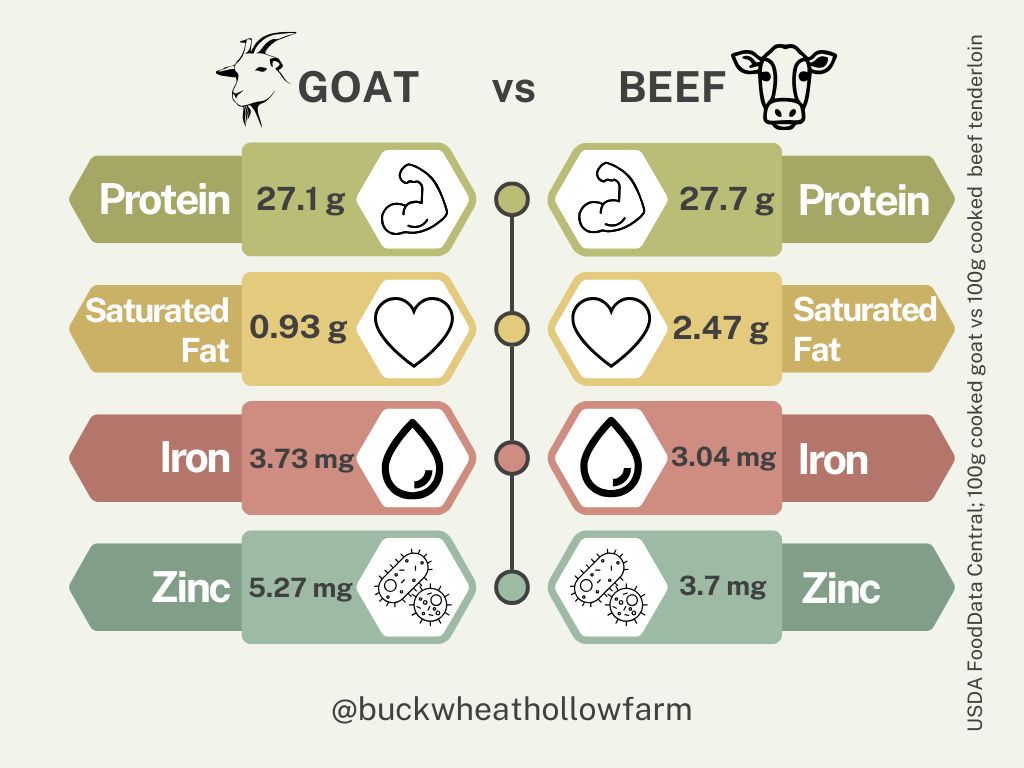
*It seems fairly common knowledge that protein is tied to muscle/tissue building, iron is important for red blood cell development (and thus oxygen transport in the body), and too much saturated fat is linked to heart disease and stroke. Zinc plays a role in having a healthy immune system, among other things. [2]
So what about me?
There is a “prejudice” against goat meat in many communities in the US, due mostly to the incorrect assumptions that all goat meat is tough and possesses a strong gamey flavor. Interestingly, this was the initial impetus for marketing goat meat under the name “Chevon” in the U.S. [1] However, continued sustainability, economic, and nutritional concerns across the globe make goat meat a sensible option for meat in the future. [5, 3]
If you are looking for a nutritious, sustainable meat source, but you’ve heard negative things about goat meat, we encourage you to read the many reviews on our website and social media. Our pasture-raised goats have a mild flavor that has been enjoyed by “goat meat aficionados” and “goat meat novices” alike.
When you’re ready to try it out, hop on over to our online store to pick up a cut you’re most familiar with. If you’d like some recipe suggestions, check out our blog or comment below and we’ll help you figure out how to fit this wonderful meat into your weekly meal plan!
Sources
[1] Casey, N.H., et al (2003). “Goat,” In B. Caballero (Ed.), Encyclopedia of Food Sciences and Nutrition.
[2] Gorman, Racheael Moeller (2025). “Zinc: What it does for the body, and the best food sources,” HarvardHealthOnline+. https://www.health.harvard.edu/nutrition/zinc-what-it-does-for-the-body-and-the-best-food-sources
[3] Kadim, I.T. and Mahgoub, O. (2012). “Nutritive Value and Quality Characteristics of Goat Meat,” In O. Mahgoub, I.T. Kadim, and E.C. Webb (Eds.), Goat Meat Production and Quality, pp. 292-323.
[4] Luginbuhl, J.M. (2015). “Is There a Market for Goat Meat in the US? Yes, There Is!” NC State Extension: News from Goats and Sheep. https://smallruminants.ces.ncsu.edu/news/is-there-a-market-for-goat-meat-in-the-us-yes-there-is/#:~:text=Although%20the%20current%20US%20market,meat%20as%20a%20gourmet%20item.
[5] Mazhangara, Irene Rumbidzai, et al (2019). “The Potential of Goat Meat in the Red Meat Industry,” Sustainability, 11(3671). https://www.mdpi.
[6] U.S. Department of Agriculture. (2019, April 1). Game meat, goat, cooked, roasted. FoodData Central. https://fdc.nal.usda.gov/food-details/175304/nutrients
[7] U.S. Department of Agriculture. (2019, December 16). Beef, loin, tenderloin roast, separable lean only, boneless, trimmed to 0″ fat, select, cooked, roasted. FoodData Central. https://fdc.nal.usda.gov/food-details/746758/nutrients